Restored Mid-Century Teak Surfboard Dining Table, c.1960s
The "Boardroom" Surfboard Dining Table (c. 1960s)
In the hierarchy of Australian Mid-Century design, the fixed-top table occupies a rarefied tier. While the vast majority of dining tables from the 1960s were designed with extension leaves to suit the modest suburban footprint, a table of this scale — sculpted to create a single, uninterrupted span — tells a different story.
This is not merely a dining table; it is an architectural statement. Measuring over 2.2 meters, pieces of this specification were almost exclusively special order commissions, designed for executive boardrooms or the grand dining spaces of architect-designed homes. It represents the pinnacle of the era's manufacturing capability, prioritising an unbroken aesthetic line over the convenience of a split extension.
THE OBJECT & MATERIALS
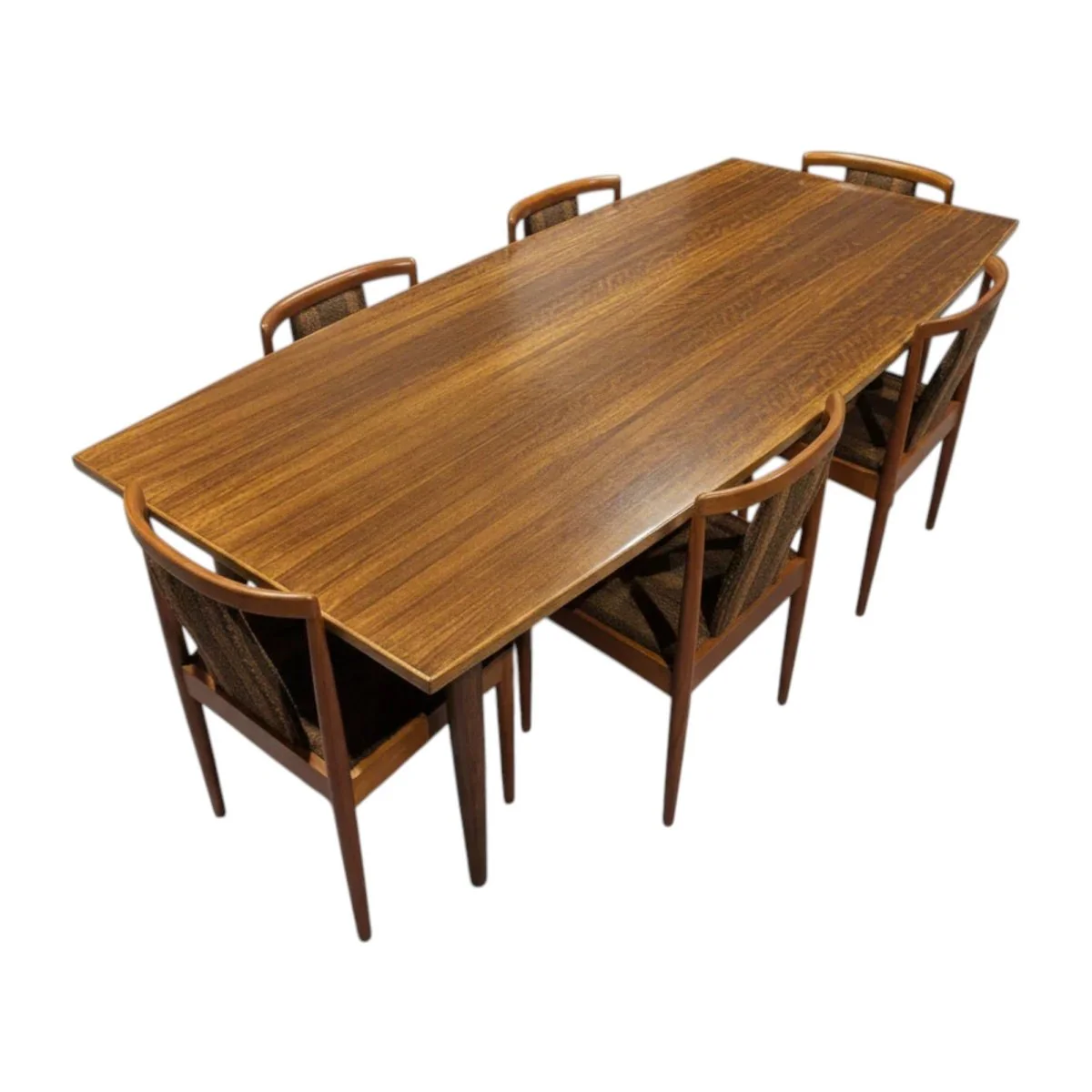
The visual command of this piece comes from its "Surfboard" silhouette — a boat-shaped profile with gently tapered ends that softens the room’s geometry, allowing for fluid movement around the dining space.
The tabletop features a vivid, crown-cut Teak veneer, selected for its expressive cathedral grain. Because the table does not extend, the timber grain flows continuously from end to end without the visual disruption of a central seam — a detail that purists and collectors actively seek. The top is framed by a substantial solid hardwood lipping, sculpted with a knife-edge profile that reduces the visual weight of the piece, making it appear to float.
A critical detail for the connoisseur is the timber selection on the base. The legs display a distinct "tiger stripe" or fiddleback figure. This chatoyant, shimmering grain is a biological characteristic of premium Tasmanian Blackwood (Acacia melanoxylon), not Teak.
This bi-material construction — pairing a golden Teak top with a structural Blackwood base — is a hallmark of Australia's finest makers, most notably Parker Furniture (Nordic Range) and Chiswell. In the 1960s, Blackwood was favored for structural elements due to its superior density and turning properties, while Teak was reserved for the expansive beauty of the tabletop. The presence of this tiger stripe figuring confirms that the original makers used only their finest, instrument-grade stock for this commission.
CONDITION
The table has been professionally restored and refinished to honor the original satin luster. The finish is heat and moisture-resistant, designed for modern living while retaining the depth and warmth of the old-growth timber. This process not just protects the timber but celebrates its natural depth and character.
The surface is pristine, showing vivid contrast and warm honey teak tones in natural sunlight. The Blackwood legs are vibrant and luminous under light. All joints checked and solid.
MATERIALS: Book-Matched Teak Veneer, Solid Tasmanian Blackwood Base
ORIGIN: Australia, c1960–1969
SEATING CAPACITY: Comfortably seats 6–10 guests (depending on chair width)
DIMENSIONS:
Length: 228 cm
Width (Center): 106.5 cm
Width (Ends): 92 cm
Height: 76 cm
The "Boardroom" Surfboard Dining Table (c. 1960s)
In the hierarchy of Australian Mid-Century design, the fixed-top table occupies a rarefied tier. While the vast majority of dining tables from the 1960s were designed with extension leaves to suit the modest suburban footprint, a table of this scale — sculpted to create a single, uninterrupted span — tells a different story.
This is not merely a dining table; it is an architectural statement. Measuring over 2.2 meters, pieces of this specification were almost exclusively special order commissions, designed for executive boardrooms or the grand dining spaces of architect-designed homes. It represents the pinnacle of the era's manufacturing capability, prioritising an unbroken aesthetic line over the convenience of a split extension.
THE OBJECT & MATERIALS
The visual command of this piece comes from its "Surfboard" silhouette — a boat-shaped profile with gently tapered ends that softens the room’s geometry, allowing for fluid movement around the dining space.
The tabletop features a vivid, crown-cut Teak veneer, selected for its expressive cathedral grain. Because the table does not extend, the timber grain flows continuously from end to end without the visual disruption of a central seam — a detail that purists and collectors actively seek. The top is framed by a substantial solid hardwood lipping, sculpted with a knife-edge profile that reduces the visual weight of the piece, making it appear to float.
A critical detail for the connoisseur is the timber selection on the base. The legs display a distinct "tiger stripe" or fiddleback figure. This chatoyant, shimmering grain is a biological characteristic of premium Tasmanian Blackwood (Acacia melanoxylon), not Teak.
This bi-material construction — pairing a golden Teak top with a structural Blackwood base — is a hallmark of Australia's finest makers, most notably Parker Furniture (Nordic Range) and Chiswell. In the 1960s, Blackwood was favored for structural elements due to its superior density and turning properties, while Teak was reserved for the expansive beauty of the tabletop. The presence of this tiger stripe figuring confirms that the original makers used only their finest, instrument-grade stock for this commission.
CONDITION
The table has been professionally restored and refinished to honor the original satin luster. The finish is heat and moisture-resistant, designed for modern living while retaining the depth and warmth of the old-growth timber. This process not just protects the timber but celebrates its natural depth and character.
The surface is pristine, showing vivid contrast and warm honey teak tones in natural sunlight. The Blackwood legs are vibrant and luminous under light. All joints checked and solid.
MATERIALS: Book-Matched Teak Veneer, Solid Tasmanian Blackwood Base
ORIGIN: Australia, c1960–1969
SEATING CAPACITY: Comfortably seats 6–10 guests (depending on chair width)
DIMENSIONS:
Length: 228 cm
Width (Center): 106.5 cm
Width (Ends): 92 cm
Height: 76 cm
Original: $2,408.45
-70%$2,408.45
$722.53Description
The "Boardroom" Surfboard Dining Table (c. 1960s)
In the hierarchy of Australian Mid-Century design, the fixed-top table occupies a rarefied tier. While the vast majority of dining tables from the 1960s were designed with extension leaves to suit the modest suburban footprint, a table of this scale — sculpted to create a single, uninterrupted span — tells a different story.
This is not merely a dining table; it is an architectural statement. Measuring over 2.2 meters, pieces of this specification were almost exclusively special order commissions, designed for executive boardrooms or the grand dining spaces of architect-designed homes. It represents the pinnacle of the era's manufacturing capability, prioritising an unbroken aesthetic line over the convenience of a split extension.
THE OBJECT & MATERIALS
The visual command of this piece comes from its "Surfboard" silhouette — a boat-shaped profile with gently tapered ends that softens the room’s geometry, allowing for fluid movement around the dining space.
The tabletop features a vivid, crown-cut Teak veneer, selected for its expressive cathedral grain. Because the table does not extend, the timber grain flows continuously from end to end without the visual disruption of a central seam — a detail that purists and collectors actively seek. The top is framed by a substantial solid hardwood lipping, sculpted with a knife-edge profile that reduces the visual weight of the piece, making it appear to float.
A critical detail for the connoisseur is the timber selection on the base. The legs display a distinct "tiger stripe" or fiddleback figure. This chatoyant, shimmering grain is a biological characteristic of premium Tasmanian Blackwood (Acacia melanoxylon), not Teak.
This bi-material construction — pairing a golden Teak top with a structural Blackwood base — is a hallmark of Australia's finest makers, most notably Parker Furniture (Nordic Range) and Chiswell. In the 1960s, Blackwood was favored for structural elements due to its superior density and turning properties, while Teak was reserved for the expansive beauty of the tabletop. The presence of this tiger stripe figuring confirms that the original makers used only their finest, instrument-grade stock for this commission.
CONDITION
The table has been professionally restored and refinished to honor the original satin luster. The finish is heat and moisture-resistant, designed for modern living while retaining the depth and warmth of the old-growth timber. This process not just protects the timber but celebrates its natural depth and character.
The surface is pristine, showing vivid contrast and warm honey teak tones in natural sunlight. The Blackwood legs are vibrant and luminous under light. All joints checked and solid.
MATERIALS: Book-Matched Teak Veneer, Solid Tasmanian Blackwood Base
ORIGIN: Australia, c1960–1969
SEATING CAPACITY: Comfortably seats 6–10 guests (depending on chair width)
DIMENSIONS:
Length: 228 cm
Width (Center): 106.5 cm
Width (Ends): 92 cm
Height: 76 cm