Porcelain slop bowl by R & J Clews Japan pattern
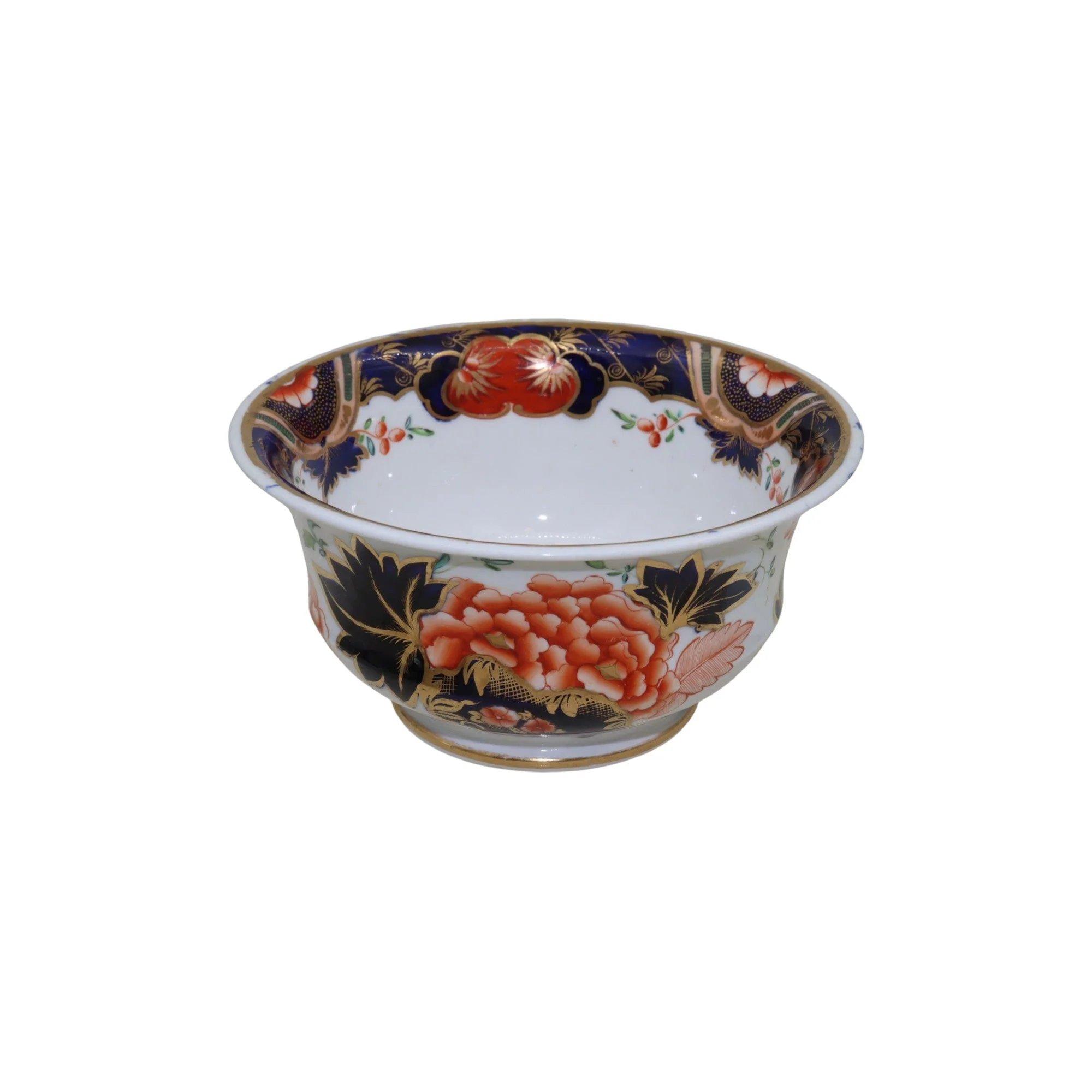
This porcelain slop bowl by R & J Clews, of Hanley in Staffordshire, is decorated with a hand painted and gilded Japan pattern, featuring some very fine painting, particularly to the fence portion of the pattern. The decoration and the painted S on the base are characteristic of the Clews, or Blue V factory. The pattern is very close to the Peover/Mrs Bowring pattern 316. The maker of the bowl is, however, unknown. The bowl has a diameter of 162 mm (6.5 inches) and it stands 82 mm (3.25 inches) high. There is minimal wear to the gilding, and it does have a repair under the lip that measures 16 mm (5/8ths of an inch) long and 5 mm (.25 of an inch) deep. It would date from around 1820.
This porcelain slop bowl by R & J Clews, of Hanley in Staffordshire, is decorated with a hand painted and gilded Japan pattern, featuring some very fine painting, particularly to the fence portion of the pattern. The decoration and the painted S on the base are characteristic of the Clews, or Blue V factory. The pattern is very close to the Peover/Mrs Bowring pattern 316. The maker of the bowl is, however, unknown. The bowl has a diameter of 162 mm (6.5 inches) and it stands 82 mm (3.25 inches) high. There is minimal wear to the gilding, and it does have a repair under the lip that measures 16 mm (5/8ths of an inch) long and 5 mm (.25 of an inch) deep. It would date from around 1820.
Description
This porcelain slop bowl by R & J Clews, of Hanley in Staffordshire, is decorated with a hand painted and gilded Japan pattern, featuring some very fine painting, particularly to the fence portion of the pattern. The decoration and the painted S on the base are characteristic of the Clews, or Blue V factory. The pattern is very close to the Peover/Mrs Bowring pattern 316. The maker of the bowl is, however, unknown. The bowl has a diameter of 162 mm (6.5 inches) and it stands 82 mm (3.25 inches) high. There is minimal wear to the gilding, and it does have a repair under the lip that measures 16 mm (5/8ths of an inch) long and 5 mm (.25 of an inch) deep. It would date from around 1820.