English Oak ‘close’ stool with Aubusson face top, c.1680
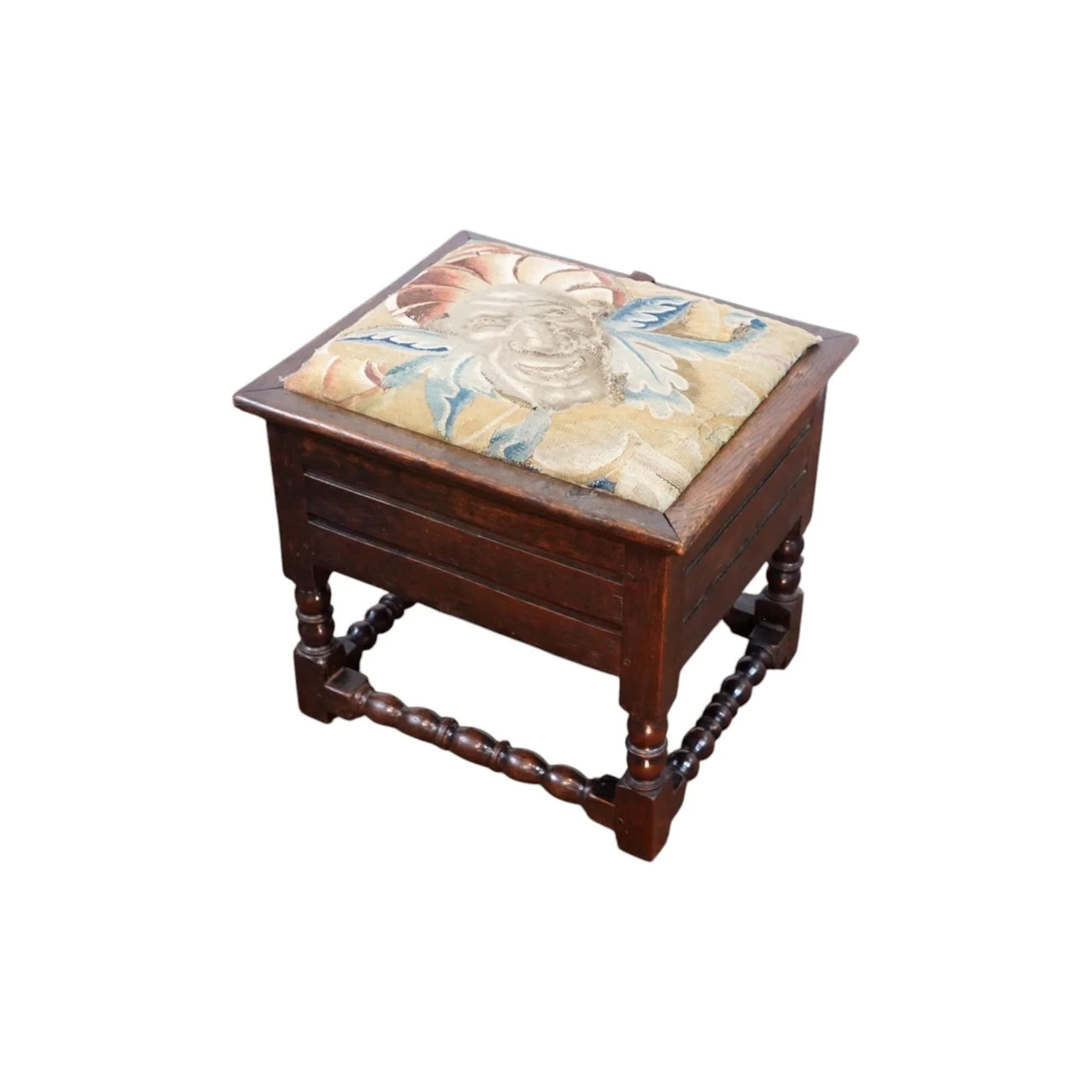
Rare English Oak 'Close' stool, with turned legs & stretchers supporting a box-like upper, the lid sporting a 17th century tapestry fragment.
Circa 1680
52x45.6cm, 45cm high
good original condition with added top, great patination
Ref. Chinnery ‘Oak Furniture - The British Country Tradition ‘ p.270 fig. 3:111 for an identical example with a solid top.
A 'Close' stool was actually a polite way to hide your toilet-pot, right in the middle of your living space!
The Aubusson face fragment is the very top left of a wide border for a tapestry of immense size and quality, and also dates to the latter 17th century.
Rare English Oak 'Close' stool, with turned legs & stretchers supporting a box-like upper, the lid sporting a 17th century tapestry fragment.
Circa 1680
52x45.6cm, 45cm high
good original condition with added top, great patination
Ref. Chinnery ‘Oak Furniture - The British Country Tradition ‘ p.270 fig. 3:111 for an identical example with a solid top.
A 'Close' stool was actually a polite way to hide your toilet-pot, right in the middle of your living space!
The Aubusson face fragment is the very top left of a wide border for a tapestry of immense size and quality, and also dates to the latter 17th century.
Original: $2,373.55
-70%$2,373.55
$712.07Description
Rare English Oak 'Close' stool, with turned legs & stretchers supporting a box-like upper, the lid sporting a 17th century tapestry fragment.
Circa 1680
52x45.6cm, 45cm high
good original condition with added top, great patination
Ref. Chinnery ‘Oak Furniture - The British Country Tradition ‘ p.270 fig. 3:111 for an identical example with a solid top.
A 'Close' stool was actually a polite way to hide your toilet-pot, right in the middle of your living space!
The Aubusson face fragment is the very top left of a wide border for a tapestry of immense size and quality, and also dates to the latter 17th century.